Recent Articles

Showing posts with label Covid. Show all posts

Wednesday, April 28, 2021

RORE Budget Response and Demands 2021-22

Rochester Organization of Rank and File Educators (RORE) 2021-2022 Budget Response and Demands

Over the past decade and a half Rochester City Schools have been intentionally deprived of funding. This upcoming year, after struggling through a global pandemic, our district has a unique opportunity to start to undo the state's denial of  the Foundation Aid owed to RCSD for 14 years and the City of Rochester’s stagnant RCSD funding for 15 years.

RCSD has the highest categories in Monroe County for economically disadvantaged population (90%), the Students with Disabilities (21.4%), English Language Learners (15%), and transportation costs per student ($2,225),  as well as increasing Charter School tuition costs ($95.8 Million).  

(Children’s Agenda, April 2021) https://thechildrensagenda.org/wp-content/uploads/2021/04/RCSD-Budget-Presentation-4-5-2021.pdf?emci=4e569dab-db96-eb11-85aa-0050f237abef&emdi=ade49ad0-e296-eb11-85aa-0050f237abef&ceid=16113265

The RCSD has been caught in a cycle of underfunding resulting in massive layoffs of staff and downsizing of schools, specialized programs, extracurricular activities, and other opportunities and resources for students.

Superintendent Lesli Myers-Small and State Monitor, Shelly Jallow, have approached the 2021-2022 budget from a deficit standpoint. They are quoting low enrollment, disregarding how the pandemic has played a large factor in Pre-K and K enrollment this past year, as well as the loss of programs and opportunities that may lead families to seek alternative education options for their students. They are quoting a student to teacher ratio of 10:1, while ignoring the number of educators who serve as co-teachers, resource providers, and teachers on special assignment. The specialized programs are required to have smaller class sizes. Educational research tells us that students perform better with smaller class sizes, rather than classes filled to the maximum allowed capacity. They are questioning sustainability, not taking into account the fact that we need to invest in the district in order to see improvement.

With the Federal Stimulus money that is being given to the RCSD this year, as well as the newly guaranteed Foundation Aid from the State, RCSD leadership is in a position to invest these funds. In providing enhanced resources and opportunities for our students. We need to provide our students and families with schools that offer them the desired support, enrichment, and opportunity.

The Superintendent and District need to be transparent about where the Stimulus and Foundation Aid funds are going, and how these funds are going to make positive change in the district. As the budget is developed, focus should also be given, and clarity provided, as to how funding will be equitably divided among all schools in the district, so that all students are receiving the same level of opportunities and resources.

1)      Increased staffing:

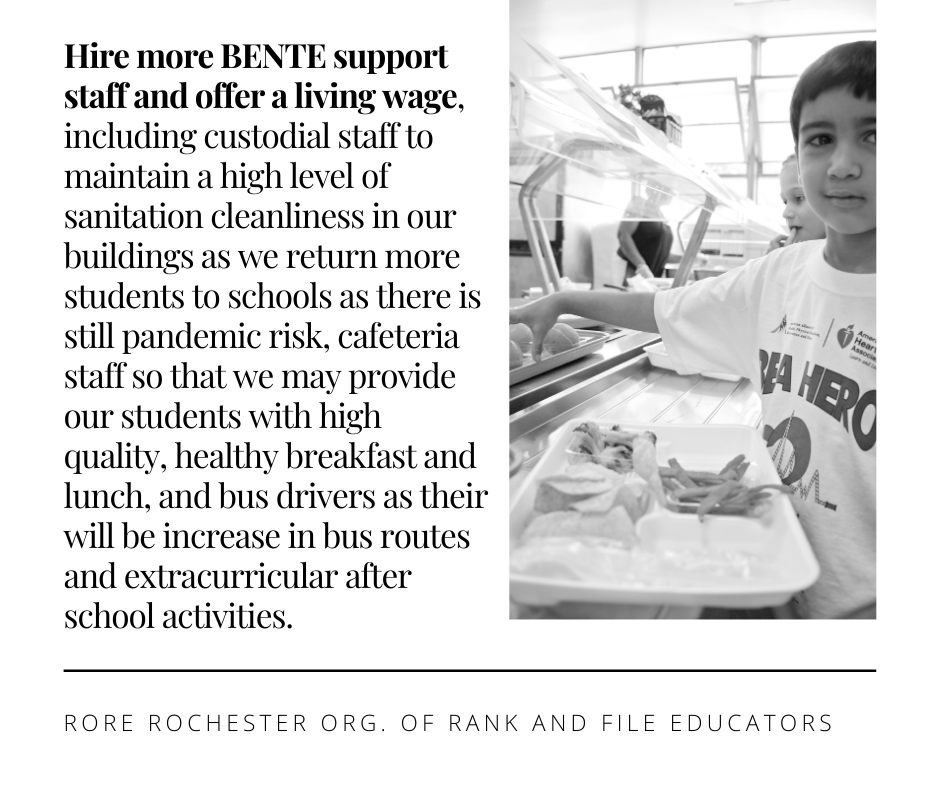
❖  Hire more BENTE support staff and offer a living wage, including custodial staff to maintain a high level of sanitation cleanliness in our buildings as we return more students to schools as there is still pandemic risk, cafeteria staff so that we may provide our students with high quality, healthy breakfast and lunch, and bus drivers as their will be increase in bus routes and extracurricular after school activities.

❖   Hire more counselors, social workers, and members of the ROC Restorative Team to provide extra Social Emotional support for students as they return to school following the pandemic. This could involve creating permanent or temporary partnerships with community programs, such as the Center for Youth, to help fill this need.

❖  Hire Intervention teachers to support students in Math and English at all levels across the District.

❖  Invest in recruiting and retaining racially, ethnically, culturally and linguistically diverse staff.

❖  Hire more art, music, library, and physical education teachers so elementary students can have art for more than a half of the school year.

2)      Extended Day, and Year Round Enrichment Opportunities for Students:

❖  Provide a “Ramp Up” program leading up to the beginning of the school year, offering the opportunity for students who have remained remote during the 20-21 school year to reacclimate to being in the school building. This program could also offer arts enrichment, resource, time with counselors, and other Social Emotional opportunities.

❖  Provide and/or invest in summer opportunities for students including arts enrichment, athletics, internships, community building, and supplementary academic enrichment.

❖  Begin development and implementation to provide year-round arts education in our Elementary Schools.

❖  Use extended school day time to provide Social Emotional support including free play for young students, opportunities for counselors to meet with small groups, arts enrichment, and restorative/mindfulness practice.

3)      Increased Staff Support:

❖  Provide increased, paid BOCES level training for paraprofessionals and teachers aides.

❖  Fully fund, and provide Anti-Racist and Anti-Bias Training for all staff, including District Leadership.

❖  Invest in the training and implementation of a more culturally responsive curriculum.

❖  Increase classroom funds so that teachers may provide better support and materials for their students, and standardize funds for all classrooms across the district.

We believe that our students will benefit most if we think intentionally and with urgency while we have the funding, and approach our budget decisions from a standpoint of investment rather than deficit. The above list offers suggestions that may appear bold to some, but they are essential to providing our students with enriching and engagement learning opportunities.  


Saturday, January 30, 2021

Same Storm, Different Boats


RCSD families, students, and staff want to go back to school in person and want to do so safely. Will that be possible this year? Is there a number of educator or student deaths that we are willing to accept in order to have in-person school? Are RCSD, the city, and the state willing to spend the money to make school reopening truly safe? These questions are of particular concern in Rochester, where 87% of students and 40% of staff are Black, Latinx, multi-racial, or Native American.The consequences of racist health care, discriminatory housing, and employment practices are that these students, staff, and their families are at greater risk of contracting and becoming seriously ill from COVID-19.

I. SAME STORM, DIFFERENT BOATS

We’re all in this together is a common slogan during this crisis. What this platitude fails to acknowledge is that, while we may all be in the same storm, we are not all in the same boat. The United States is at an unprecedented moment of overlap between a global pandemic, deep economic recession, and an uprising for Black Lives that exposes the structural race and class fissures that have resulted in higher unemployment, exposure, infection, and death rates in Black and Brown poor communities.

THE COLOR OF COVID-19

Unsurprisingly, the data is increasingly showing that Black and Latinx Rochestarians account for disproportionate COVID-19 cases or deaths. Latinx residents, 20% of the population, have accounted for 45% of COVID-19 cases and Black residents, 39% of the population, have accounted for 43% of the deaths. Black and Latinx communities are more likely to experience economic and social factors that increase risk of illness and death. Below are just some examples:
  • More likely to live in high-density housing (making social distancing difficult), because of decades of residential housing segregation caused by institutional racism. 8.8% of Rochester children were homeless at one point during the 2016-17 school year. 75% of homeless students in Monroe County are in the city of Rochester. 78% of homeless students in Monroe County were living with friends or family, also known as “doubled up”.
  • More likely to live in multi-generational households, increasing the risk of infection of vulnerable older family members. Such living situations also make it more difficult to isolate if an individual gets sick, as space may be limited. In Rochester, 86% of all virus fatalities had underlying health conditions.
  • More likely to live further away from medical centers and to be uninsured, leading to poorer underlying health and barriers to care, increasing the likelihood of severe illness and death from COVID-19. For example, Black, Latinx, and Native American individuals are more likely to have chronic illnesses such as obesity, heart disease, diabetes, and lung disease — all of which are linked to higher COVID-19 fatality.
  • When employed, more are likely to be required to work outside the home in “essential” jobs that place them in harm’s way for infection. For example, although Black workers make up only 12% of all employed workers, they make up 36% of all nursing, psychiatric, and home health aides.
  • More likely to have a job without paid sick leave, increasing their exposure to other workers who may be infected, and increasing the likelihood that they themselves will expose others to COVID-19. Latinx workers are less likely to have access to paid leave compared to White workers.
  • More likely to rely on public transportation, increasing the risk of viral exposure.
  • More likely to live in areas with poorer environmental and air quality, increasing the likelihood of preexisting health conditions. Rochester’s children are diagnosed with asthma at a high rate; 20% of RCSD students have been diagnosed with it, compared to less than 8% of school-age children that have asthma nationally.
  • Undocumented immigrants are ineligible for most governmental relief funds, and ineligible to enroll in the Affordable Care Act. More than 5 million U.S.-born children who have undocumented-immigrant parents are likely to suffer extreme poverty. As a result, they are much more likely to be uninsured and thus more likely not to receive the health care they need.
  • Over 4,000 (17%) of RCSD students are English Learners (ELs). While many ELs are native born, they overwhelmingly come from immigrant families. In addition to similar healthcare context as undocumented immigrants, EL’s families face added difficulties in poor translation or no translation in their native language.
  • The rate of COVID-19 cases among Black people in Monroe County is 4 times that of White people
  • The rate of COVID-19 cases among Latinx people is 2.5 times that of White people
  • Black and Latinx people are more than twice as likely than White people to die from COVID-19

The effect on human lives is quantifiable: the disproportionate effect of coronavirus means that at least twice as many Black, Latinx, and Asian Americans died because of structural racism that puts them more at risk compared to White people. Continuing the phased restart of physical schools during the pandemic will inevitably increase the risk of infection and death for all Rochesterarians, but especially for over 25,000 RCSD students and families who fall into a vulnerable category because of race and/or poverty.

Friday, August 14, 2020

Internet For All Petition

After COVID-19 forced Rochester public schools to cancel in-person classes, thousands of students have been unable to continue their learning online. Spectrum promised low-income households two free months of its discounted “Internet Essentials” package, but many have been left unconnected due to restrictions and requirements placed on this offer. This digital divide is especially felt by Black students, nearly half of whom lack internet connectivity at home. After July 1st, our most vulnerable Rochestarians will be expected to pay for the Internet Essentials package, which is slower than 89% of connections nation-wide. Even as Black and low-income students struggle to even log on to class, Spectrum has yet to open existing higher-speed networks for free to those in need.

This callous stance appears even worse given the years of support Spectrum has received from Rochester taxpayers. Spectrum has received billions in assistance from a 20% property tax cut, city tax allowances since 2007, as well as the Tax Cuts and Jobs Act of 2017. In 2019, such corporate welfare enabled Spectrum to post a profit totaling $16.9 billion, 5.0% higher than in 2018, and CEO Thomas Rutledge made $8.16 million in salary and incentives in 2018, a 5% rise over his 2017 total compensation.

Despite calling Rochester its home and receiving billions in support from its neighbors, Spectrum has failed to support our most vulnerable students in this unprecedented time by refusing to provide students with the assistance they need. Though Spectrum has pledged to take action against digital disparities, the urgency of this pandemic calls for current efforts to be directed toward what is most needed—access to reliable, high quality internet.

To meet the needs of our most vulnerable students, we are petitioning Spectrum to:

1) Offer the Internet Essentials program for free to all low-income Rochester homes with students now throughout the end of the 2020-2021 school year

2) Increase the upload speed of Internet Essentials from 3 Mbps to 25 Mbps and the download speed from 25 Mbps to 100 Mbps

References and further reading:

1) Auxier, Brooke, and Monica Anderson. “As Schools Close Due to the Coronavirus, Some U.S. Students Face a Digital 'Homework Gap'.” Pew Research Center, 16 Mar. 2020, URL (petition banner image)

2) Nasr, Amir. “The Perilous Future of Internet Access for Students of Color.” New America, 12 July 2018, URL

3) Paul Ericson. "Why Digital Disparity Persists" Rochester Beacon, 31 January 2019, URL

4) Paul Ericson. "The cost of digital disparity in a pandemic" Rochester Beacon, 15 April 2020, URL

Click Here to Add Your Name

Monday, August 3, 2020

Monroe County School Reopening Proposal

Background and Context

In the same way that the state is taking a deliberate and careful approach to reopening the economy, the state must take an equally deliberate and careful approach to reopening our public schools. Having spent approximately 25 percent of the 2019-2020 school year in crisis mode and learning remotely, all of our students — regardless of socioeconomic status or race — will be coming back with social, emotional and academic needs that we don’t yet fully understand. The health and wellness of the students and staff of the Rochester City School District is intrinsically linked to that of students and staff in all of Monroe County. Any reopening plan must be uniform across the county to acknowledge the interconnectedness of our communities. Public health crises do not recognize town boundaries.

The nearly 60,000 students whose families are living in poverty will have even more acute trauma than they carried before the pandemic. The intersection of COVID-19 and the Black Lives Matter movement compels us to examine and dismantle structures of racism and classism in society and in the institution of public education. Our schools cannot go back to the conditions under which they operated before COVID-19 or we will fail our students, families, educators and communities at the time of their greatest need. This moment provides us with an exciting opportunity to transform public education to adapt to our new reality.

Educators will need to develop new skills, strategies, teaching methodologies and curricula that match the conditions we will be returning to under any of the three models (remote, in-person or hybrid). Students and their families have ongoing needs that must be met — before and upon return to school. School buildings across Monroe county are not yet equipped to meet environmental health and safety standards. To be ready to return, we need time to prepare buildings and physical settings; plan and learn new skills; and welcome and acclimate our students and families. And we need full funding and staffing to address the myriad facets of teaching and learning during a global pandemic.

Local associations and local districts should determine the plan to start the year with that best suits their context — be it remote, hybrid or full return with health and safety protections — and then determine a secondary plan for changes in context. Standing labor management committees should be established immediately to provide opportunities for regular communication and feedback to the district regarding reopening planning and implementation. MOUs should be negotiated as dictated by local governing practices. Additional stakeholders such as families, students and community members should also be given ongoing and systematic opportunities to be engaged and to give input. The local plan should be a living document, the goal of which is to provide a vehicle for ongoing partnership and collaboration with educators, families, communities and students. 

Monday, July 27, 2020

Not Until It's Safe - Sign Our Open Letter

An open letter to union and district leadership: 


To the President of the Rochester Teachers Association, Adam Urbanski, the President of the Rochester Association of Paraprofessionals Angie Rivera, and Board of Education Non Teaching Professionals President Dan DiClemente and Lesli Myers-Small, RCSD Superintendent: 


We as parents, educators, staff members in the Rochester City School District are writing to express our support for the #14daysnonewcases campaign. As parents, we want nothing more than to keep our children safe and to work with teachers and the district to make the right choices for our children. As educators and staff, we are dues-paying members of RTA, RAP, and BENTE and need you to use our strength in numbers to stand up. Our unions and leaders must formally declare that we will not return to campus until our county reports no new cases of COVID-19 for at least 14 days.

While there’s nothing we want more than to see our students in-person again, and to see our children thrive in their school environment, it is far too dangerous for our children, our families, and our colleagues to resume in-person instruction this fall. Until it is safe, we must develop and implement a more robust distance learning program for the children. To allow our students to equitably access this distance learning program, we must also demand that our students be provided with all necessary technology, such as personal computers and high-speed internet access.

States and school districts are unveiling reckless, unethical school reopening plans that put our colleagues and their families, our students and their families, and ourselves in extreme danger. Even in countries that have far better controlled the pandemic, they have had to close schools soon after reopening them. Schools in China and South Korea have closed after infections flared up. Students and staff have contracted COVID-19 in schools after they reopened in Canada, France, the Netherlands, and Israel, forcing them to close again. The number of COVID-19 patients under 10 years old in Oregon has increased fivefold, matching the number of cases in patients over 80 years old. More than 17,000 children under the age of 18 have contracted COVID-19 in Florida alone. Now new research suggests that children transmit COVID-19 just as easily as adults do.

These trends and research clearly demonstrate that it is irresponsibly dangerous to reopen school campuses this fall. If elected officials and district officials want campuses to reopen, then they need to implement the public health measures that they should have implemented months ago, including, but not limited to: mass testing, contact tracing, and strict suspension of nonessential business and travel activity. Our governments also must provide the economic relief we and our students need to endure these public health measures, including, but not limited to: basic income, rent and mortgage cancellation, protection from eviction, and single-payer healthcare throughout the pandemic.

As educators and staff members, we know how impossible it will be to implement strict physical distancing, mask enforcement, constant sanitation, and hybrid learning on every campus in our district. As parents, we do not and should not expect our teachers and children to endure these harsh and harmful conditions emotionally, mentally and physically. We all would rather everyone stay healthy and alive than pressured into dangerous and emotionally damaging situations. We must refuse to return to campus until our county reports no new cases for at least 14 days.

We need our unions and leaders to stand up to protect all, not just the few.

Signed, 

Monday, June 29, 2020

RTA & RAP Members Re-entry Survey


Let your voice be heard.

As our district makes plans for what the 2020-2021 school year might look like, make sure you share your opinions.

This survey has been adapted from the Oakland Education Association, in preparation for the 2020-2021 school year.

Plan on needing 5-10 minutes to complete the survey. Share widely. The more feedback we can share with our leadership, the better their understanding will be of the desires of their members.

This survey was created by RORE.  Only collective data will be shared with RTA, the District and the rest of the community.  No identifying information will be shared.

Click Here to Begin the Survey